

I Concur
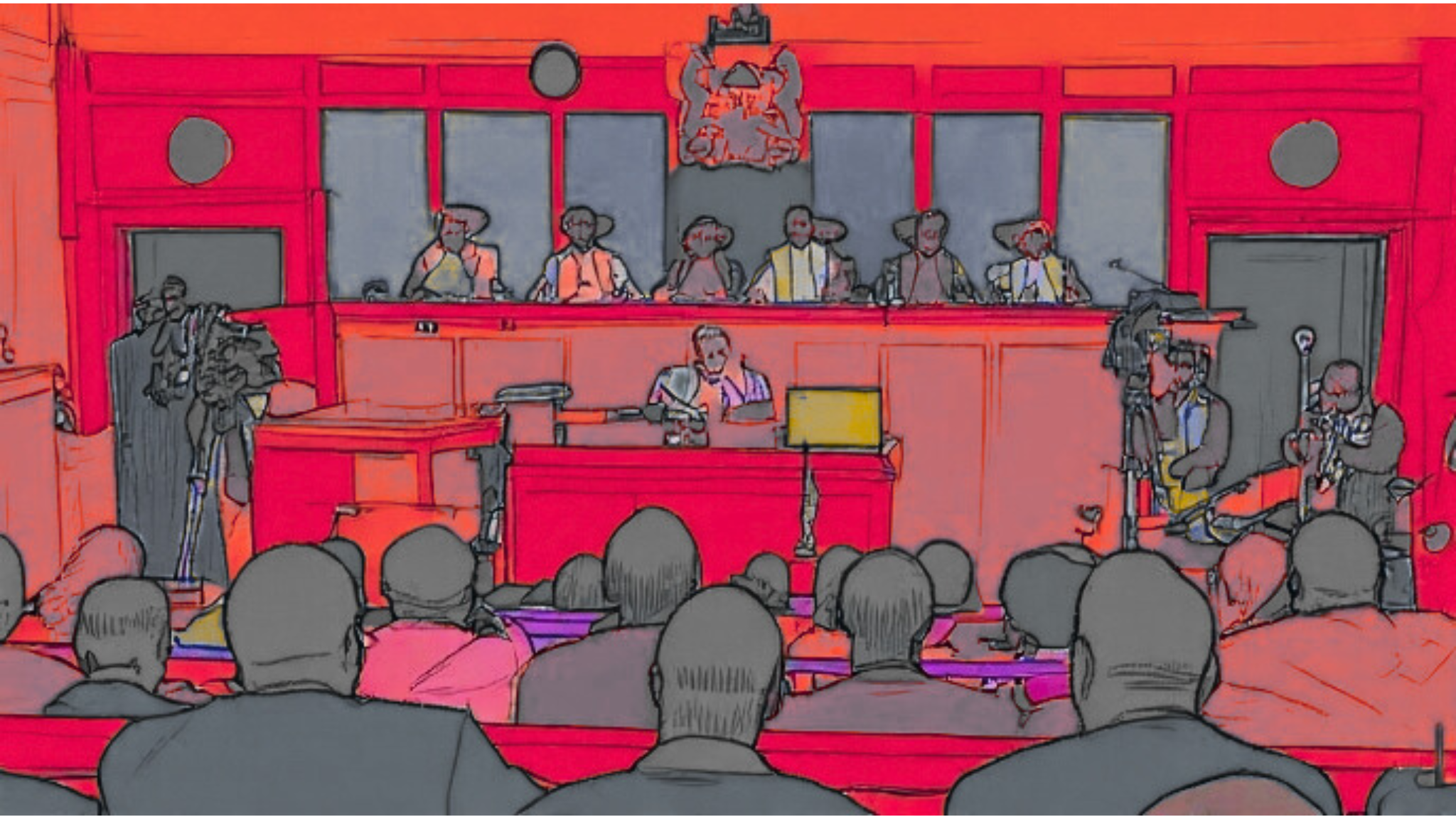
This image was generated to depict inside a court room in Ghana.
My niece or “Ama Dede,” as my mum insisted on calling her — has been in my head about this High Court case since the start. She sent me links, voice notes, and the kind of rapid-fire commentary only a Gen-Z girl can deliver, and finally said, “Uncle Ben, please tell me what you think — because this whole case makes no sense.”
So, Ama, this is for you. And for everyone else trying to understand why two widows stood before a judge to be recognised as spouses of the late Charles Kwadwo Fosu — the legendary Daddy Lumba.
What I think is simple: the Court got it right.
I think it did. I concur.
Not because of sentiment or gossip, but because when you strip away the emotion, the law in this case did something quite rare in our public life: it reflected reality rather than flattening it. Ghana does not live under a single, neat concept of marriage. We operate in a plural legal system that recognises ordinance (civil) marriage, customary marriage, and Islamic marriage — each with its own internal logic and requirements. That is not an accident or a loophole; it is a deliberate acceptance that our social lives cannot be squeezed into one imported template. Any honest analysis of the Lumba case must begin from that fact.
In court, one woman asked to be declared the sole lawful spouse, relying on an alleged ordinance marriage celebrated in Germany. The other stood on a customary union lived out over years, defined by cohabitation, children, family integration, and public acknowledgment. The legal question was not which woman was morally superior, or which relationship evoked more sympathy. The question was which claims could be sustained under Ghanaian law and evidentiary standards.
The civil marriage claim faltered on its own foundations. To displace all other unions and claim exclusivity, an ordinance marriage must be proved with the rigour that civil registration demands. Foreign marriage certificates require authentication, certification, and compliance with both the foreign system and Ghanaian rules of recognition. None of this was satisfied. The German documentation, as reported, did not meet the evidentiary threshold. Courts do not operate on sentiment; they operate on proof. You cannot claim the protections of a system you cannot demonstrate you ever entered.
By contrast, the customary marriage was not speculative; it was lived. Under Ghanaian law, customary marriage is a fully legitimate form of union, even without a written certificate. It is established through recognised rites, family consent, continuous cohabitation, and public acknowledgment. For decades, this is how countless Ghanaians have married and built families. The union between the deceased and Odo Broni — measured by these standards — was clear, concrete, and consistent. It produced children, a household, and a life together. Erasing that marriage in favour of a claim that lacked proper proof would not have been justice; it would have been legal erasure.
This is where the judgment shows its true strength. The court refused to allow a weak exclusive claim to invalidate a strong established one. It refused to turn documentary deficiency into human dispossession. It recognised that justice is not achieved by choosing the relationship that looks neatest on paper, but by acknowledging the one that is legally and socially grounded.
Critics worry that recognising two spouses undermines marriage or sanctions confusion. But this view quietly assumes that Ghana has, or should have, a single monogamous regime governing all unions. Our statutes contradict this. Customary polygynous marriages are not legal anomalies; they are lawful and widely practised. You may disapprove morally or religiously, but disapproval does not rewrite the law. If you want the legal exclusivity of an ordinance marriage, you must create it properly — and live consistently with it. The court cannot fill in your omissions after the fact.
The discomfort many people feel is less about law and more about visibility. The ruling forces society to confront realities often kept private — the existence of multiple households, relationships spanning borders and legal systems, women and children who are too often rendered invisible once property, inheritance, and reputation enter the conversation. The court refused to engage in that erasure.
To concur, therefore, is not to endorse anyone’s lifestyle but to endorse legal honesty. If a man lives as a husband to more than one woman, the law should not pretend otherwise simply to satisfy the aesthetics of monogamy. If a civil marriage is desired, the burden of ensuring its exclusivity rests with those who claim it, not with the court.
Two women walked into that courtroom not as stereotypes but as individuals whose lives, children, and futures hung in the balance. To declare one legitimate and the other irrelevant would have been unjust and unsupported by the evidence. The law did what integrity demanded.
Yet this case also serves as a cautionary lesson, not only for celebrities but for ordinary Ghanaians who do not wish for their private lives to turn into public litigation. It forces us to confront an uncomfortable truth we often avoid: many of the relationship tragedies that unfold in death began with the moral shortcuts taken in life. Ghana is full of women who became single mothers not because they chose to raise children alone, but because the men who promised them partnership treated commitment as optional. Too many women cook, clean, build homes, nurture families, and hold entire households together for years, only to discover — often too late — that the man they loved never formalised their union, never introduced them to his extended family, never secured their future, and never once made their place in his life legally undeniable.
We have created a culture where some men maintain wives at home and treat their “side chicks” like unofficial spouses, leaving both women emotionally entangled in roles that society pretends not to see but the law cannot ignore. These relationships exist in shadows until the man dies, and then suddenly the real wife is confronted with a stranger claiming to be “the woman he truly loved,” or the partner who shared a roof and a life but has no documents to prove her place. Death exposes what pride, secrecy, and infidelity try so desperately to hide. And when it is all said and done, it is usually the women who are left to suffer — unsupported, unrecognised, and forced to defend their dignity in a courtroom if they can afford it, while the man who caused the confusion lies silent. They grieve twice: once for the man they loved, and again for the life they believed they were building together. Their tears, unlike court judgments, come with no appeals.
So let this be a moral warning. If the sight of two widows standing before a judge makes you uneasy, let it remind you that the law only clarifies what you failed to organise in life. If you want a monogamous ordinance marriage, register it properly, file it where it belongs, and live accordingly. If you choose a customary union, formalise it with witnesses and family involvement. If you intend to marry abroad, ensure your certificate is valid under Ghanaian law. If you have children across households, write a will early. And above all, if you desire simplicity, do not live a life that depends on judges to interpret your intentions after your death.
And to you, dear Ama: let this be your takeaway as you grow into your own womanhood and make decisions that will one day shape your family’s future
This is not legal advice, of course — proper legal advice does not come free, and this column will not replace a paid consultation with your lawyer even if he doubles as your uncle. But it is an opinion grounded in the simple reality that legal clarity is a kindness you offer the people you will one day leave behind.
As the dust settles on this case, what remains is a principle worth keeping: the law cannot tidy up a life lived untidily. It can only apply fairness to the facts before it. And in recognising both women, the court chose clarity over fantasy, evidence over presumption, and justice over sentiment.
For these reasons — legal, factual, and ethical — I concur.